Focus keyphrase and content analysis
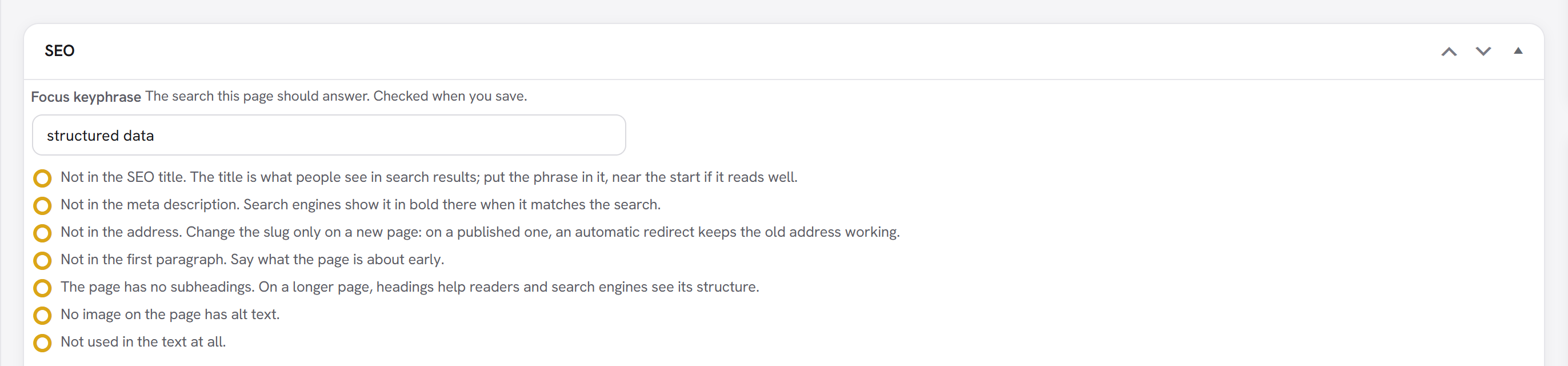
At the top of each page's SEO box, Focus keyphrase is the search the page should answer: crab linguine recipe, emergency plumber Harbourtown. Save the page and the box lists, check by check, whether the page uses it where it counts.
The checks
| Check | What it looks at |
|---|---|
| SEO title | The title search engines will show (your template or the page's own). |
| Meta description | The description that will be used. Search engines show matching words in bold there. |
| Address | The page's slug. Change it only on a new page; on a published one, an automatic redirect keeps the old address working. |
| First paragraph | The first real paragraph of the content. |
| A subheading | Any H2–H6, including page-builder heading elements. |
| Image alt text | Alt text of the featured image and the images in the page. Only where it truly describes the image. |
| Used in the text | How many times, out of how many words. A count, not a density target. |
| Another page's focus | If another published page has the same focus keyphrase, it is named: two pages aiming at one search compete with each other. |
The phrase is matched as a phrase. Letter case and punctuation are ignored (Crab-Linguine Recipe! matches), and nothing looser: the words in another order, or inside longer words, don't count. A check that guesses would sometimes be wrong, and a wrong check is worse than none. A tick means the words are really there.
The checks describe the saved page, so save to see them change. They read the content and the page builder's text and headings.
Readability
Shown as measurements rather than a grade:
- the average sentence length, and how many sentences are over 25 words;
- how many paragraphs are over 150 words.
Long sentences and walls of text are what make a page hard to read on a phone, in any language. Grades from reading-ease formulas only fit English, so none is given.
Heading structure
Two problems are pointed out:
- a level skipped going down (an H2 followed by an H4), which leaves screen-reader users and search engines with a broken outline;
- an H1 inside the content: the page title is the H1 in nearly every theme, so headings in the content start at H2.
Across the site
The Audit runs the same checks on every page and lists the pages for each problem.