Links
Internal links are one of the few things about search you fully control, and the usual problem is not knowing where things stand. SEO → Links reads every link in your pages and answers three questions.
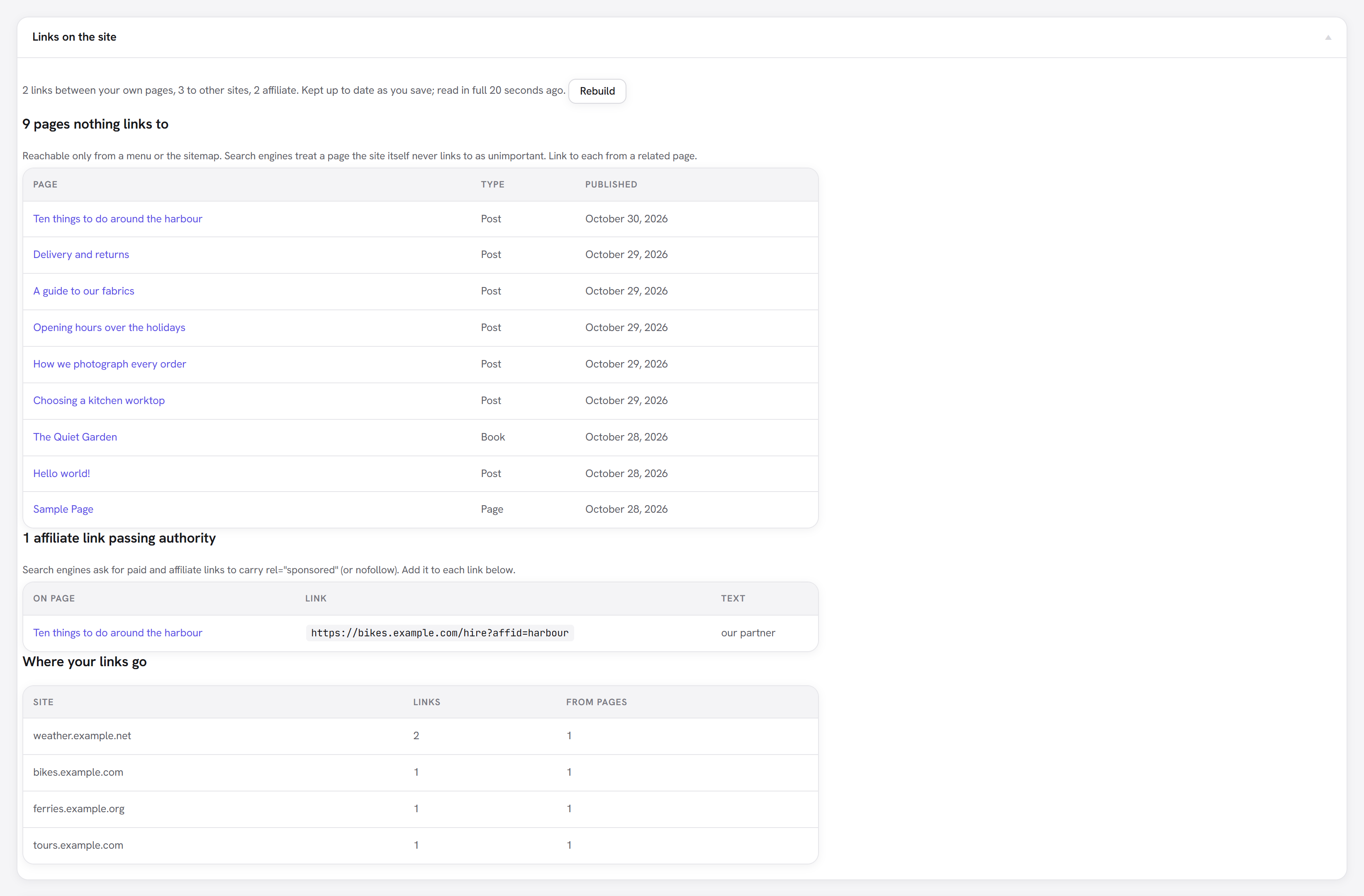
Which pages does nothing link to?
An orphaned page is one no other page on the site links to. Visitors and search engines can only reach it through a menu or the sitemap, and search engines read a page the site itself never mentions as unimportant. Orphans pile up without anyone noticing: a post nobody linked from older articles, a landing page left out of the content.
The fix is a link from a related page. The list shows each orphan with its type and date, newest first, and links to its editor. The home page and the blog page are left out, since everything reaches them through the menu.
The same answer shows in the editor: the page's SEO box says Linked from 4 other pages on the site, or that nothing links to it, so you find out while you are already working on the page.
Which affiliate links still pass authority?
Search engines ask for paid and affiliate links to carry rel="sponsored" (or nofollow). A link
without it passes your site's authority to the advertiser, which they treat as a link scheme. The report
lists each affiliate link that has neither, with the page it is on and its text.
A link counts as affiliate when:
- it goes through the usual redirect folders on your own site:
/go/,/out/,/recommends/,/refer/,/visit/,/aff/…; - it is one of your short links, which almost always redirect to an advertiser;
- it carries an affiliate tracking parameter such as
aff_id=,affid=orclickref=; - it matches one of your own patterns (below).
Your own patterns: under Affiliate links → Also count as affiliate, one per line: a folder on
your site starting with / (/deals/), or a site's address (partner.example.com, which also covers
its subdomains). Rebuild after changing them.
Where do your links go?
Every outside site you link to, with how many links and from how many pages, most-linked first. It shows at a glance which third parties your content points readers to.
Suggestions: where links could go
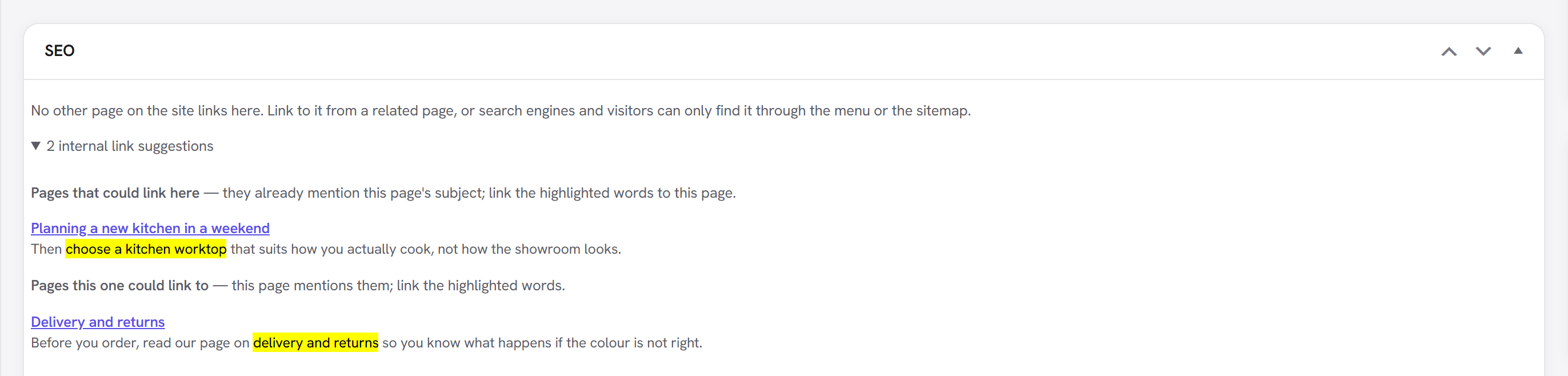
Each page's SEO box has a collapsed internal link suggestions line, in both directions:
- Pages that could link here. Other pages whose text already mentions this page's subject but don't link to it. The words are already there; they only need a link.
- Pages this one could link to. Other pages whose subject this page mentions, unlinked.
Each suggestion shows the sentence, with the words to turn into the link highlighted, and links to the page to edit. Nothing is linked automatically: you decide whether the link reads well.
How the subject is found. A page's subject is its title, trimmed to the words that matter: How to choose a kitchen worktop becomes choose a kitchen worktop. That phrase is looked for as whole words in the other pages' text, including the text of page-builder elements. So that the suggestions stay believable:
- titles too vague to place a link on are skipped: one word ("Garden") or very short ("About us");
- a match must be inside a real sentence, not a heading, a card title or a list of recent posts that is just the title;
- pairs that are already linked are left out;
- pages sharing a title are one suggestion, and pages on the same subject as this one aren't suggested at all, since they compete for the same searches rather than link to each other;
- at most five in each direction.
Suggestions are worked out when the page is opened and kept for 12 hours (sooner after the page is saved). Like the rest of this report, no AI is involved: every suggestion can be explained by the words that matched.
What is read
- The content of every published page, post and other content type the SEO extension covers.
- The page builder: link fields on buttons, cards, icon boxes and other elements, and links inside
rich text. A link on a button is found as reliably as one in a paragraph. A button's nofollow switch
counts as its
rel. - Not the header, footer, menus or sidebars. They link to everything on every page, and counting them would hide every orphan.
Images, background images, # placeholders and mailto: / tel: links are not counted.
Keeping it current
The first time the report is opened, it reads every page in the background, 50 pages at a time; a site with a few hundred pages takes well under a minute. After that each page is re-read when it is saved, and its links disappear from the report when it is unpublished or deleted. Rebuild reads everything again.
Limits
- A link to an archive (a category, a tag, the blog) is counted as internal but doesn't make any page "linked to". Orphans are about individual pages and posts.
- Links that a theme or another plugin adds when the page is shown are not in the content, so they are not counted.
- Affiliate detection is a pattern match. A link through a tracking service it doesn't recognise counts as external; add its address under Also count as affiliate.