Topic momentum
Google Trends answers what on-page work can't: whether interest in a topic is rising or draining away, when in the year it peaks, and which of two phrasings people actually type. It does not report search volume: its numbers are relative to the peak of whatever you asked about.
SEO → Topic momentum imports what Trends exports and joins it with what your site already knows.
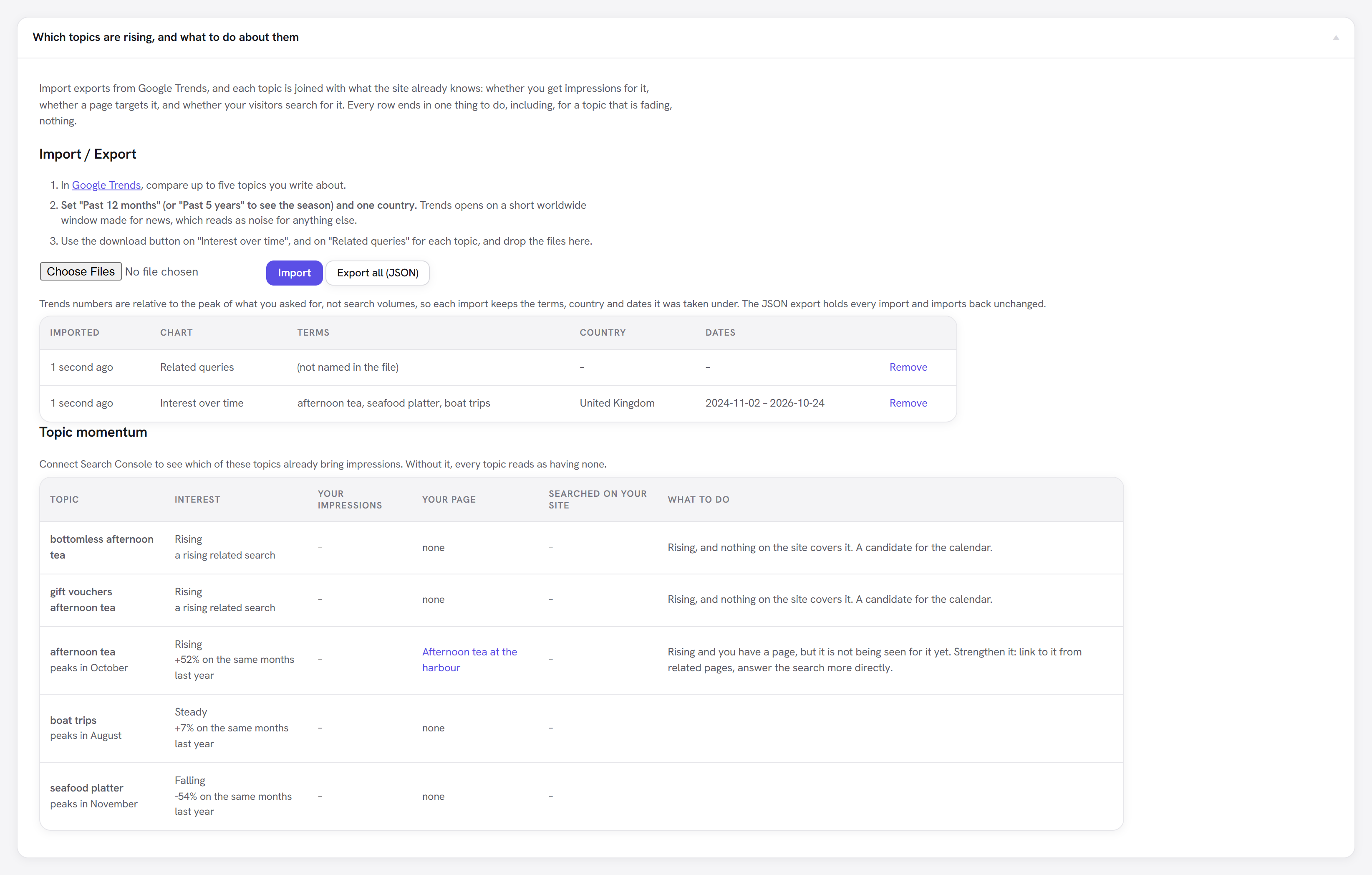
Importing from Trends
Trends has no API, but every chart downloads as a CSV.
- In Google Trends, compare up to five topics you write about.
- Set "Past 12 months" (or "Past 5 years" to see the season) and one country. Trends opens on a short worldwide window made for news desks, which reads as noise for anything else.
- Use the download button on Interest over time, and on Related queries for each topic, and drop the files on the screen. Several at once is fine.
Each import is stored with the terms, country and dates it was taken under, read from the file itself, because two exports made under different settings are not comparable. Export all (JSON) downloads every import, and importing that file brings them back unchanged, onto another site too. Remove deletes one.
The table
Each topic, from Interest over time (and each rising search from Related queries), with:
| Column | |
|---|---|
| Interest | Rising, falling or steady: the last three months against the same months a year earlier when the export covers that far (which takes the season out), otherwise against the three months before. 20% either way counts. Also the month it peaks. |
| Your impressions | Impressions in the last four weeks for searches that contain the topic (Search Console). |
| Your page | A published page whose title or focus keyphrase is the topic. |
| Searched on your site | How often visitors typed it into your search box (Site search). |
| What to do | The one thing worth doing, below. |
| What it sees | What to do |
|---|---|
| Rising, seen in Google, page exists | Refresh the page before the peak. The most valuable row on the screen, listed first. |
| Rising, seen in Google, no page | Write the page you are already half-ranking for. |
| Rising, not seen, no page | An open gap, a candidate for the calendar. |
| Rising, not seen, page exists | Strengthen the page: link to it from related pages, answer the search more directly. |
| Falling, page exists | Nothing. The market moved, not the page; don't spend a week "fixing" it. |
A topic that is rising and that your own visitors search for is flagged: about as strong a signal as a small site gets.
With an AI connection, the rows worth writing about have Draft a title and outline: a proposed title and section headings for the page, which you can use or ignore. The analysis itself never uses AI; every row is explained by the numbers in it.