Where your pages rank
Search Console already knows the average position each page appeared at for every search that showed it. This puts that to work in two places: a list of the searches almost on page one, and, in the editor, every search the page you are editing appears for.
It runs on the Search Console connection — nothing further to set up.
Almost on page one
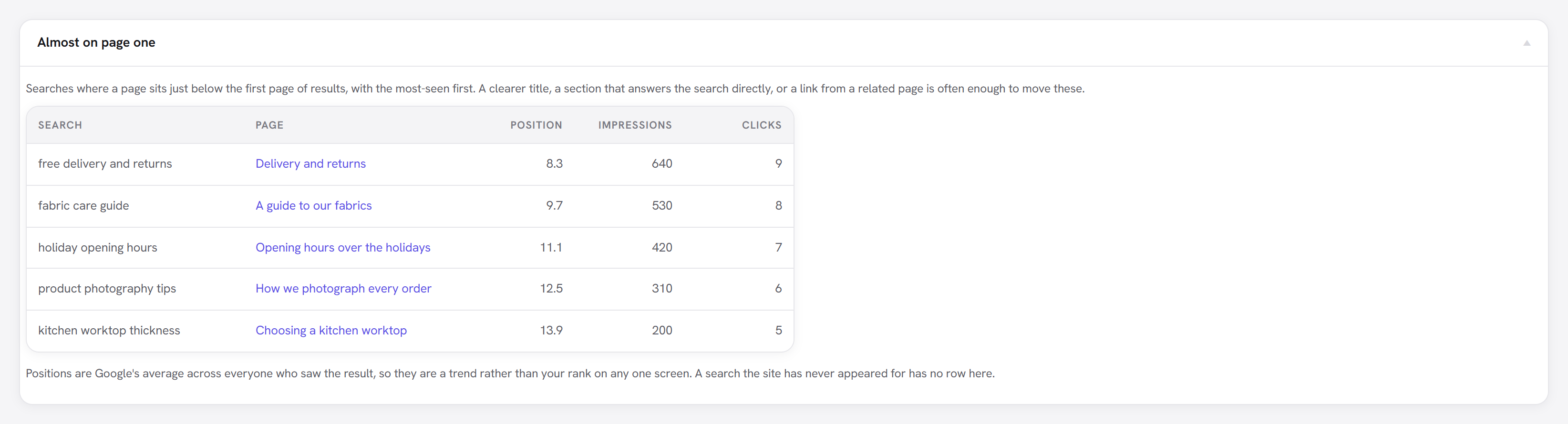
Searches where a page sits at positions 8 to 15, most-seen first. That band is where effort pays: close enough to the first page that a modest improvement moves it there, far enough down that almost nobody scrolls to it. A page at position 40 needs a different page; a page at 11 often needs a better title, a section that answers the search directly, or a link from a related page.
Only searches with at least 30 impressions over the last four weeks are listed. Below that an average position is a handful of people on one day, and rewriting a page because of it is acting on noise.
Each page links straight to its editor.
In the editor
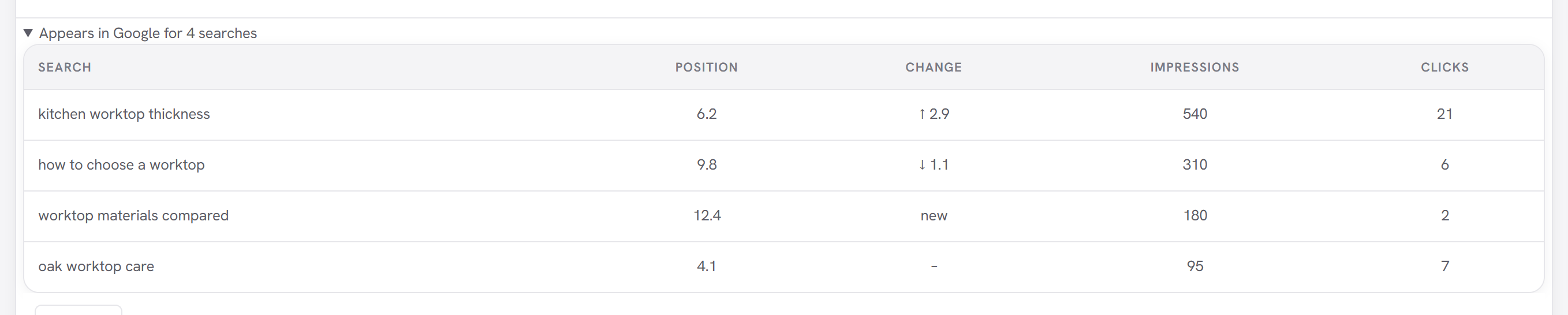
Above the SEO panel, a collapsed line — Appears in Google for 4 searches — opens to the searches this page already shows up for, with the most-seen first. It is collapsed because it is useful when you are rewriting the title and in the way the rest of the time.
The Change column compares the last four weeks with the four before:
| Shows | Means |
|---|---|
| ↑ 2.9 | Moved up almost three places — a smaller position number is better. |
| ↓ 1.1 | Slipped about one place. |
| – | Moved less than half a place, which is noise. |
| new | The page did not appear for this search in the previous four weeks. |
It only appears on published pages, once Search Console is connected and has something to report for the page.
What this is not
It is not a rank tracker. The position is Google's average across everyone who saw the result — different places, devices and personal histories. Treat it as a trend. Your position on one screen, in one city, can be several places away from it.
It cannot show a search you have never appeared for. No impressions means no row. Tools that report a position for any keyword do it by querying Google from many locations on a schedule, which is a paid scraping service — not something your own Search Console data can provide.
It is about four weeks old at its newest edge. Search Console data lags by about three days, and the windows are four weeks long so a single quiet day does not read as a collapse. Results are cached for six hours.