Structured data
Meta tags describe a page. Structured data describes what the site and its contents are — which is what produces a knowledge panel, a proper site name in results, an author byline and the sitelinks search box.
The extension publishes one JSON-LD @graph per page. A single connected graph rather than a
pile of separate blocks, because the connections are the useful part:
- The page's
publisherreferences your identity node instead of repeating it. - Every author gets a stable
@id, so the same writer across twenty posts is one entity rather than twenty unrelated names — which is what lets a search engine accumulate a reputation for them at all. - The page declares itself
isPartOfthe website.
Everything in the graph is read from the same resolution chain as your meta tags. The headline is the resolved SEO title, the description is the resolved meta description, the image is the one your share card uses. They cannot drift apart — and structured data that contradicts the tags beside it is worse than none, because it is the machine-readable copy and it is the one that gets believed.
Site identity
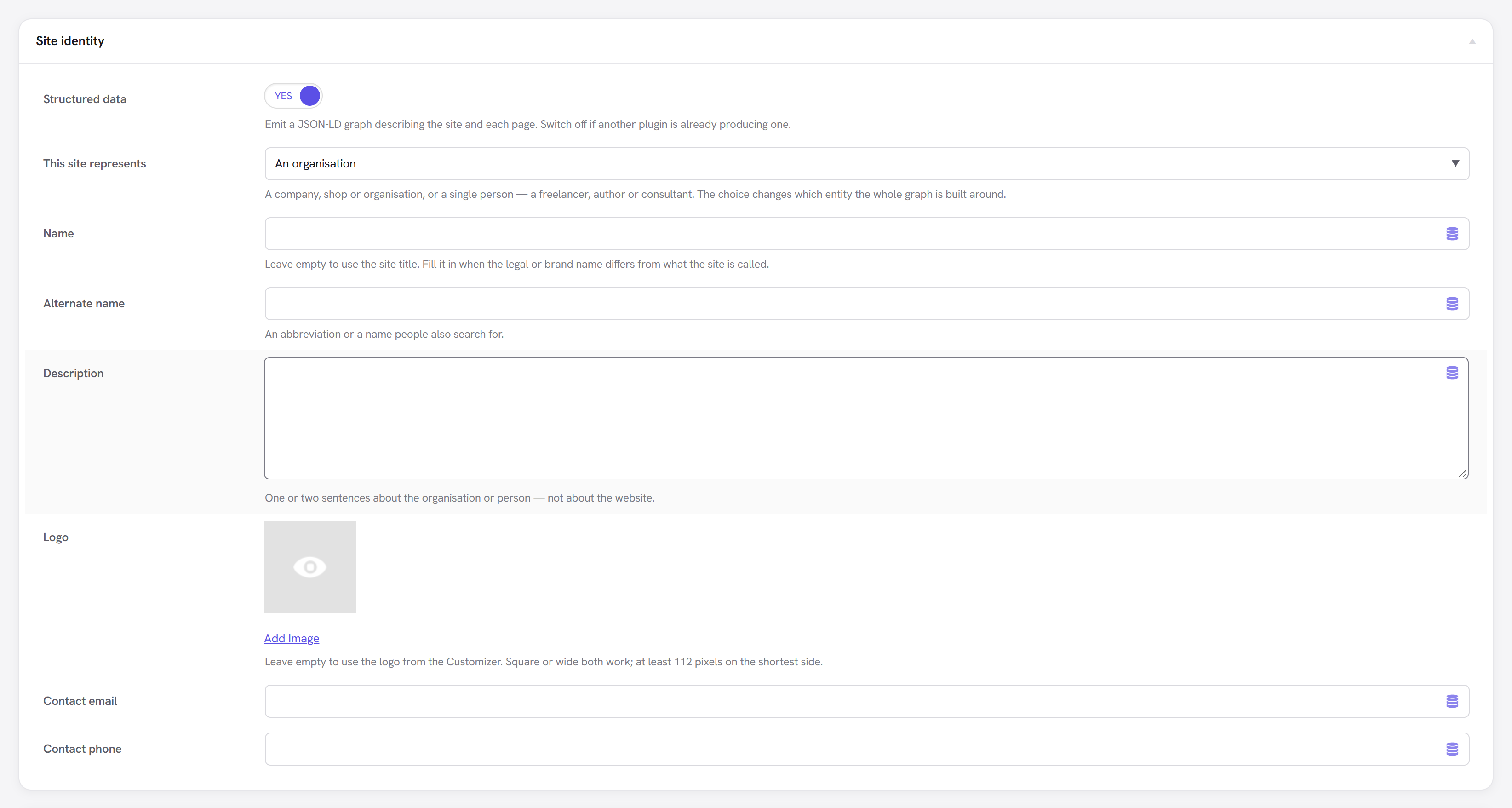
Under Unyson+ → SEO → Structured data, say whether the site represents an organisation or a person — a freelancer, author or consultant. The whole graph is built around whichever you choose.
Then the details worth stating explicitly rather than having guessed: name (when the legal or brand name differs from the site title), an alternate name people also search for, a description of the organisation rather than the website, a logo, and contact details.
Your social profiles become sameAs here — the property that tells a search
engine which accounts are genuinely yours. Only full URLs are published: a bare handle is
dropped rather than emitted, because sameAs only means anything if every entry resolves.
What each content type is
Each content type chooses what it publishes as: Web page, Article, Blog post, News article, or No structured data.
The list is deliberately short. schema.org defines hundreds of types, most of which no search engine treats differently, and a long dropdown invites picking something specific and wrong. News article in particular is a claim to be a news publisher, which is a claim search engines check.
A Web page carries no byline and no publisher, because most pages have neither in any meaningful sense. Putting an author on a contact page is a small lie that a rich result will happily repeat.
The WebSite node and its search box are emitted only on your home page. Google reads them from there, and repeating them on every URL does not make a search box more likely — it just makes every page claim to be the site.
FAQ data
The accordion element publishes its own
FAQPage data when you switch on its FAQ rich snippet option, and that continues to work
unchanged. It is currently emitted as a separate block rather than joined into the graph
above — see the roadmap.